Ok, I am doing my revision for my DACE C1. Hope I can summarise all the things we have learnt so far.
Dewey (1933) on Reflective Practice: A process of analysing, reconsidering and questioning experiences within a broad context of learning and teaching issues.
Schon (1983)
Reflection-In-Action : when practice is taking place. When you are doing it
Reflection-On-Action: after the practice or after the event
Brookfield's (1995) Critical Reflection
- Autobiographies as AEs and learners : introspective examination of one's history, beliefs and intentions underlying decision and actions taken in any learning environment
- Learner's perspective : from our student's eyes, end of course feedback
- Colleague's perspective : new perspective and opinion for what is seen to be happening
- Theoretical Literature : to validate one's informal practice using formal source of information
Principles of Reflection
- Levels of Reflectiveness : to distinguish between superficial and deep reflection, everyday type of reflection that is random and fleeting to a higher level of reflection that is more deliberate and systematic.
- Need for Context : dynamic and ever changing environment -> need for constant RP. WSQ framework 4 approaches to conceptualizations are the need to be aware of legal, industrial, organisational and operating environment considerations
- Many Roles & Responsibilities of AE : Different role, different perceptive
- Involvement of Stakeholders : A critical peer may point out the taken for granted habits and question the practice of them by challenging the status quo
- Action Orientation :result of the interplay of knowledge and practice will lead to action which is informed by evidence
Five methods of reflective practice
- Journaling
- method of collating thoughts and ideas, and later organizing these thoughts and ideas in a systematic way
- identify patterns of thought and the basis for self-discovery
- follow-through action to interpret entries for meaning
- follow-up action as part of professional development
- Form, intended audience, Frequency, Focus, Time-frame, Review, Feedback
- use of metaphor and analogy will enhance articulation of experience and interpretation
- Critical Incident Analysis
- personal critical incidents and critical teaching incidents
- Describe it, Importance of incident to AE, Reaction during incident, relate incident to beliefs and values
- Self-Reflection and Self-Questioning
- Method : What am I doing here ?
- Reason : Why am I doing this ?
- Result : What is the outcome ?
- Justification : Will I change anything based on the information gathered from answering the first 3 questions ?
- Peer Observation
- inviting peer to comment on and to provide feedback on any work done
- pre-observation discussion to agree on objectives and purpose of observation
- the observation proper to collect and record evidence of good practice
- post-observation discussion for feedback and direction for follow-up
- Critical Friendships
- engaging RP through dialog with another person (trusted friend)
- Inventories
- ....
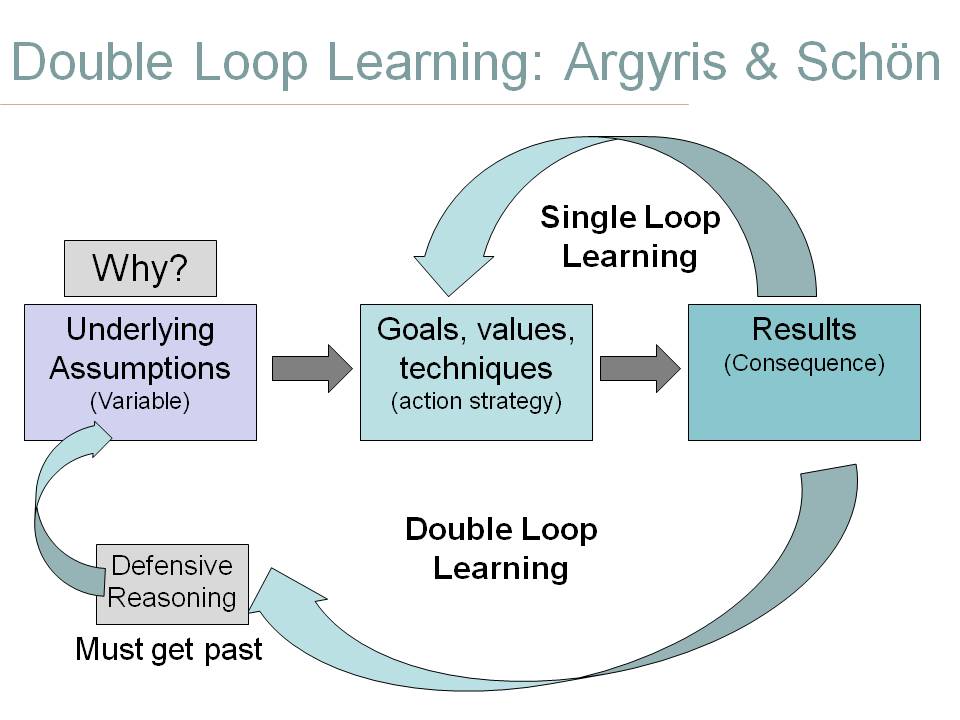
Argyris & Schon : Single loop and double loop learning
Core Values of PD Framework
- Passion for Lifelong Learning
- The Uniqueness of Every Adult Learner
- Improvement of professional Practice
- A Spirit of Inquiry and Innovation
- Authentic Learning
- Adaptability and Resilience
Great Links on Reflective Practice
Critical Reflection : a summary of a few approaches to RP
